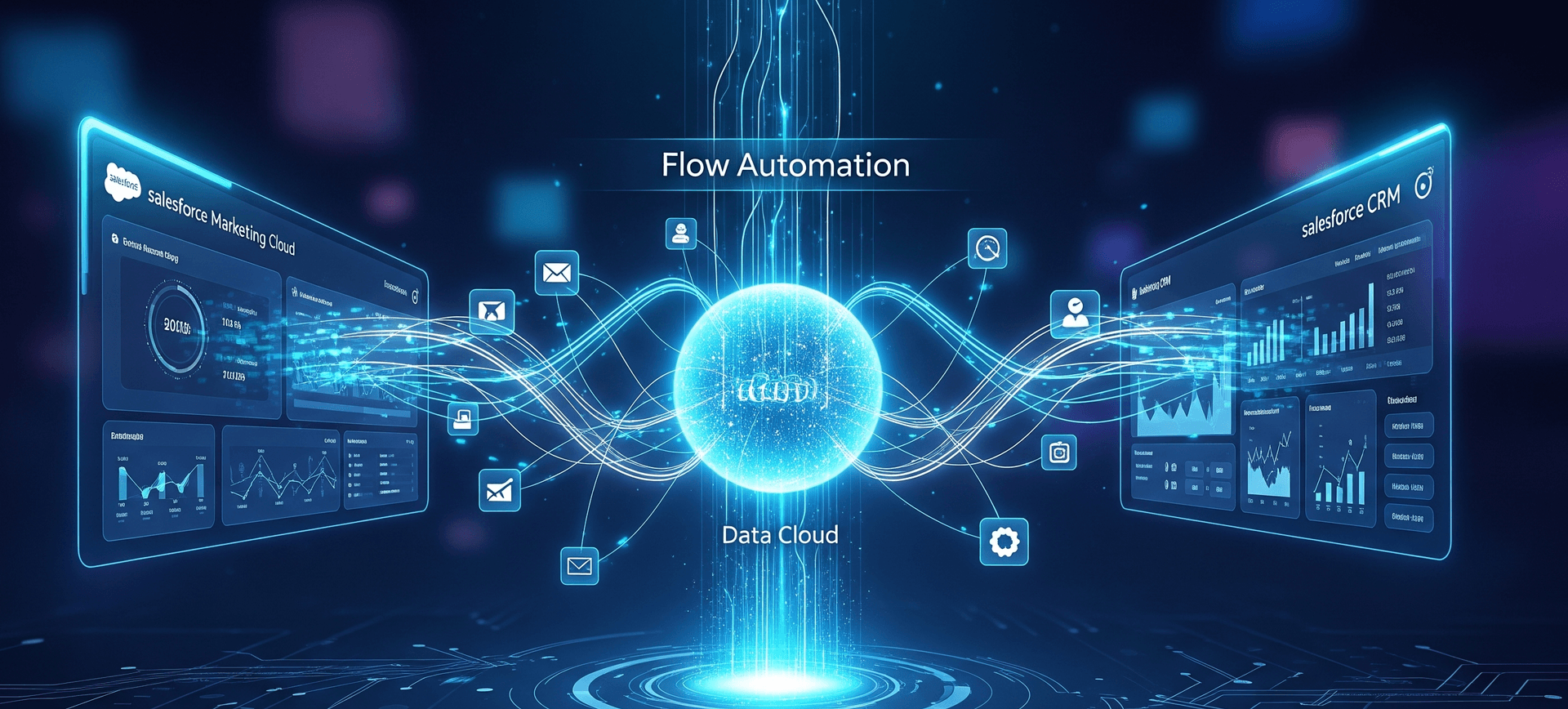
Every new year brings fresh buzzwords, but 2025 feels different. Salesforce has announced Marketing Cloud Next not as a separate platform but as a capability increasingly built into the Salesforce core. For those of us who've followed Marketing Cloud from its ExactTarget days, this shift represents more than a rebrand: it's a realignment of how marketing, data, and automation will work together.
Why This Matters
When marketing tools sit apart from CRM, teams end up syncing data, reconciling reports, and patching gaps. By bringing Marketing Cloud closer to the Salesforce core, Salesforce is setting up a future where:
- Data moves seamlessly between Sales, Service, and Marketing
- Integration overhead drops, with fewer connectors to maintain
- Insights live in one place, making ROI easier to measure
This isn't about replacing what works. It's about building a smoother path forward.
What Changes for Marketers
The biggest evolution will be in how journeys are orchestrated. Journey Builder, long the workhorse of Marketing Cloud Engagement, is gradually being aligned with Flow, Salesforce's automation backbone. Instead of building in silos, marketers will be able to orchestrate cross-cloud experiences directly through Flow.
At the same time, Data Cloud steps into the role of intelligence layer unifying customer profiles, behaviors, and signals in real time. This means every campaign or Flow can tap into a single source of truth for personalization and targeting.
Together, these elements connect through Marketing Cloud Next as the engagement hub. Rather than asking, "Do I build this in Marketing Cloud or Salesforce?", marketers will begin thinking, "Which experience am I activating, and how do Flow and Data Cloud power it?"
Access Through Existing Marketing Cloud
One key point: this isn't a rip-and-replace move. Marketing Cloud Next is designed to be accessible from within existing Salesforce Marketing Cloud Engagement (ExactTarget) accounts. In practice, this means current users won't have to start from scratch they'll see Next capabilities show up as part of the same environment they already log into today.
For marketers, that's a relief. The familiar workflows remain, but they'll gain tighter Salesforce integration and the ability to orchestrate through Flow and personalize through Data Cloud all without losing access to the tools they already know.
Looking Ahead
2025 may well be the year we stop seeing Marketing Cloud as a standalone system. Instead, it becomes part of a connected Salesforce ecosystem with Flows driving orchestration, Data Cloud powering insights, and Marketing Cloud Next delivering the engagement layer.
Closing Thought
The journey forward isn't about sunsetting old tools, but about tying them together in smarter ways. For marketers, that means less time stitching systems, and more time designing experiences that customers actually notice.